
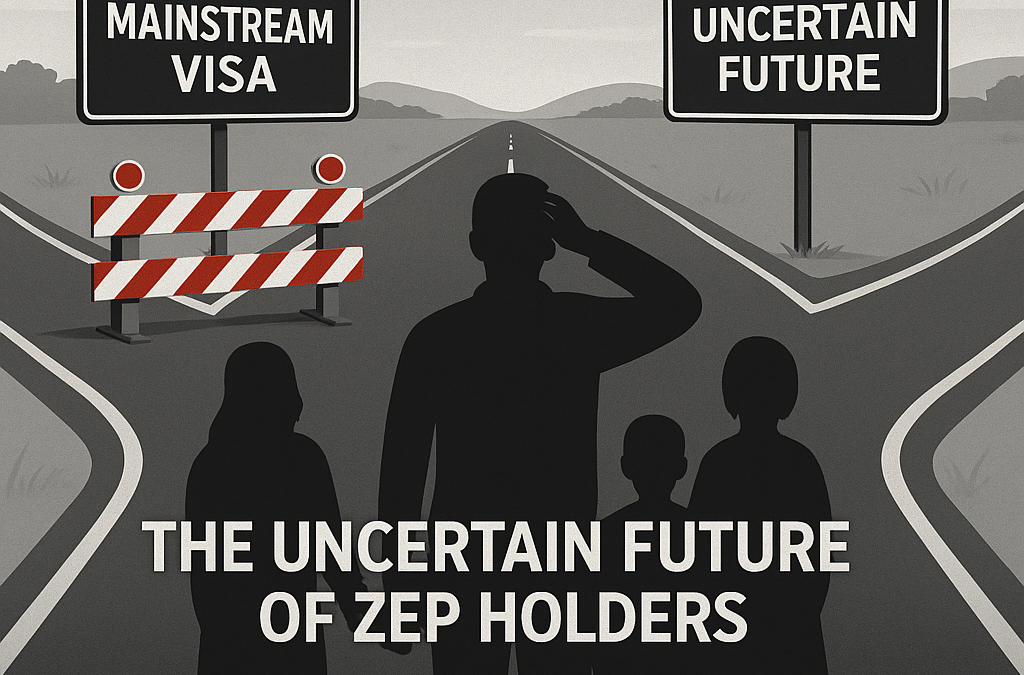
It has been more than two years since the landmark High Court judgment in the Hellen Suzman case, which set aside the Minister of Home Affairs’ decision not to extend the Zimbabwe Exemption Permits (ZEP). Following that ruling and subsequent related judgments the Minister extended the ZEP permits until 29 November 2025. Now, with just over two months remaining before that deadline, questions loom large.
Despite the court directing the Minister to reconsider the matter in line with sections 3 and 4 of the Promotion of Administrative Justice Act (PAJA), no such process has taken place. Time is running out, and with more than 170,000 ZEP recipients and their families waiting for certainty, one wonders whether their fate will ever be resolved.
A Process That Cannot Be Concluded in Time
By all accounts, this matter is far from settled. Sections 3 and 4 of PAJA require a public participation process, including adequate notice to affected parties. With only two months left, there is simply not enough time to bring this ongoing saga to a final conclusion.
Meanwhile, ZEP holders remain in a state of perpetual uncertainty. Within this uncertainty, four distinct groups have emerged:
- Applicants Who Moved to the Mainstream Visa System
This group comprises individuals who heeded the call to transition to mainstream visas such as Critical Skills, General Work, and other categories. Many applied early, yet their applications remain unresolved.
Despite complying with every requirement, they have had to endure excessive delays, with adjudication moving at a much slower pace compared to non-ZEP applications. It is unclear why those who have sought to regularise their stay remain trapped in this limbo.
- Those Who Applied for the ZEP Extension (Until November 2025)
For those who secured the extension, the future after 29 November 2025 remains uncertain. The conditions of their current exemptions clearly state they cannot change status while inside South Africa. This leaves them entirely dependent on the Minister’s next move.
- Permit Holders Who Did Not Apply for Either Option
A growing number of ZEP holders fall into this category they neither applied for the extension nor transitioned to mainstream visas.
Their position is legally confusing:
- Two court orders prohibit action against them.
- A ministerial directive imposes conditions on their stay.
As a result, it is unclear whether they are in the country legally or illegally. Paradoxically, their situation is still more favourable than that of the fourth group.
- Families and Dependents of ZEP Holders
Perhaps the most vulnerable group is made up of dependents spouses and children on accompanying visas linked to the ZEP holder. They were not given any consideration when the ZEP termination was announced in 2021.
Many have been undocumented since December 2021, unable to resolve their status independently. Unlike in previous interventions where the Minister provided interim protections, this group was completely overlooked in the last round of directives.
What Lies Ahead?
The fate of ZEP holders and their families remains elusive. Those who managed to apply for mainstream visas under the relaxed conditions introduced by the Minister are in a relatively better position, as the visa (once issued) will be valid for five years. But with no clarity on when those visas will actually be finalised, uncertainty persists.
For everyone else, the future lies in the hands of the Minister—or perhaps once again in the hands of the courts.
A Broader Problem
The ZEP crisis highlights a larger issue: the lack of legal certainty in South Africa’s special permit programmes. Legal certainty is a cornerstone of our constitutional order, yet the ZEP programme and others before it, such as the Lesotho and Angolan dispensations remain in states of chaos and neglect.
Until a sustainable, transparent, and lawful framework is introduced, ZEP holders and their families will continue to live with uncertainty.